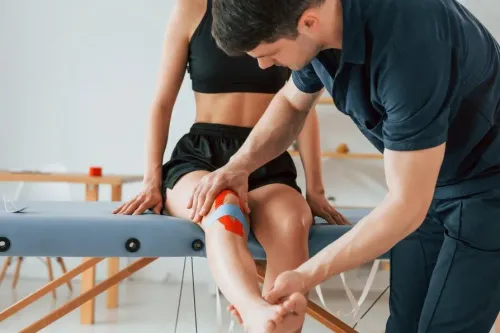
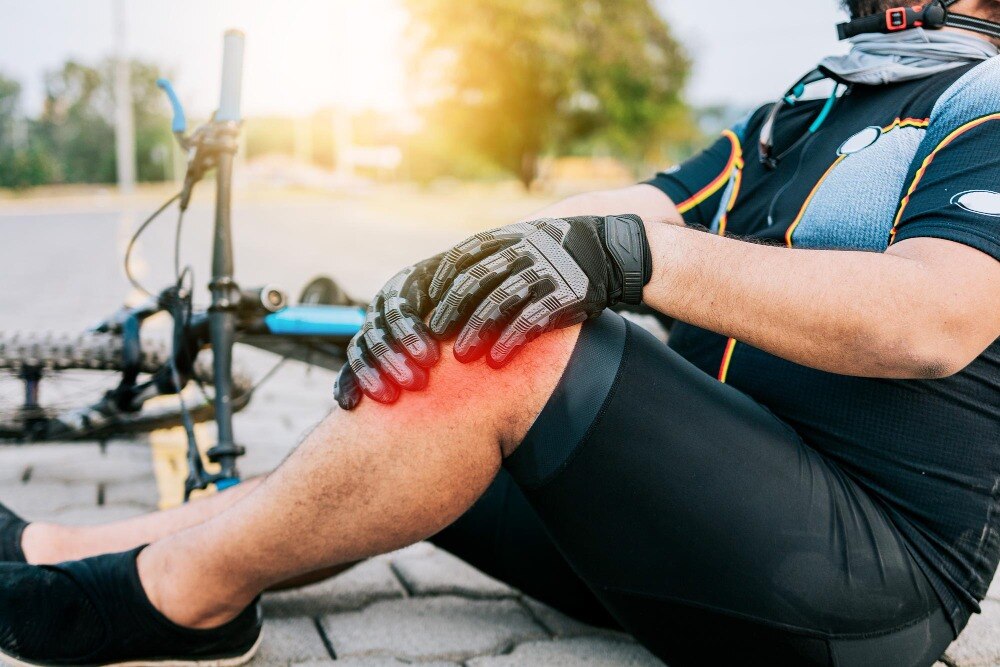
A hard landing, collision or road crash can break a bone, dislocate a joint or damage soft tissue, and the first response affects safety. You will learn how to recognise an emergency, protect the injury before care, understand imaging and fracture patterns, and see why treatment and return-to-sport decisions differ from one person to another.
Key takeaways
- Treat deformity, exposed bone, blue skin or numbness as an emergency.
- Do not straighten or push back a suspected fracture.
- X-rays help distinguish fractures from sprains, dislocations and muscle injuries.
- Return to sport only after pain-free movement, strength and medical clearance.
How do you recognise a fracture and know when it is an emergency?
A possible fracture signs after a sports injury or road accident include deformity, severe swelling, abnormal movement, inability to bear weight, numbness, pale or blue skin, or bone visible through the skin. Pain alone cannot confirm a break, but these signs need medical assessment.
Call emergency services for uncontrolled bleeding, an open fracture, loss of sensation, a cold or discoloured limb, suspected spine or pelvic injury, head injury, or breathing difficulty. These situations need emergency fracture care, not a routine orthopedic review. Road crashes can also injure the chest, abdomen, spine, pelvis or head.
- Keep the person still and support the limb in the position you found it.
- Cover an open wound with a sterile dressing or clean cloth.
- Apply ice wrapped in cloth, without pressing on a deformity.
- Avoid food or drink if surgery may be needed.
Do not straighten the limb, push exposed bone back under the skin, massage the injury, test it by walking, or remove an embedded object.
Watch for compartment syndrome symptoms after a high-energy tibia or forearm fracture: escalating pain, tight swelling, or pain when the muscles are passively stretched. This requires urgent assessment even when a pulse is present; numbness, paralysis and absent pulses are late signs, not safe reasons to wait.
How is a suspected fracture distinguished from a sprain, dislocation or muscle injury?
Pain and swelling alone cannot identify the injury. The same symptoms occur with:
- Fractures
- Dislocations
- Ligament sprains
- Muscle injuries
A clinician compares the injured side with the other side and checks:
- Alignment and deformity
- Exact bony tenderness
- Active and passive movement
- Skin colour, wounds and pressure points
- Circulation, including pulse, warmth and capillary refill
- Sensation
- Motor function
They repeat these neurovascular checks after splinting, reduction or surgery because swelling, pressure or a changed bone position can threaten nerves and blood vessels even when a pulse remains present.
For fracture diagnosis, an X-ray for fractures is usually the first test and identifies most straightforward breaks. A CT scan fracture study defines complex, displaced or joint-involving fractures more precisely. MRI can reveal an occult fracture and damage to ligaments, tendons, cartilage or muscle.
A scaphoid fracture can hide on the first wrist radiograph. Anatomical-snuffbox tenderness warrants wrist immobilization and repeat X-rays, CT or MRI rather than reassurance from a normal report. In a child, persistent focal tenderness after injury can indicate a growth-plate fracture that is invisible initially; missed damage can later cause growth disturbance or deformity.
Immobilization protects the area while repeat imaging reveals a fracture that becomes visible or confirms soft-tissue injury.
Which fracture patterns are common after sports injuries and road crashes?
A fracture’s pattern reflects both the force involved and what the force did to the bone and surrounding tissues.
| Pattern | What it means | Common setting |
|---|---|---|
| Closed fracture | The skin remains intact. A wound near the fracture is treated as open until clinicians prove otherwise. | Sports injuries or falls |
| Nondisplaced fracture | The bone cracks or breaks but stays aligned. | Lower-force impact or stable loading injury |
| Displaced fracture | Broken pieces shift out of alignment. | Twisting, direct impact or high-energy crash |
| Comminuted fracture | The bone breaks into multiple fragments. | Road crashes and other high-energy trauma |
| Stress fracture | Repetitive loading creates a small crack rather than one sudden break. | Running, jumping and other sports; a stress fracture is a sports injury |
| Growth-plate fracture | The break involves the cartilage zone guiding bone growth. | Children and adolescents |
An open fracture has a wound connecting the fracture area with the outside environment, even if the opening is tiny. Bacteria can enter, so treatment often includes urgent antibiotics, tetanus assessment, surgical cleaning and stabilization.
Sports injuries usually produce localized fractures, while road crashes can create high-energy injuries involving the chest, abdomen, pelvis, spine or head. Severe swelling, bleeding, skin damage, nerve or vessel injury, or suspected compartment syndrome can make the situation more urgent than the bone’s appearance suggests.
Escalating pain, especially pain during passive muscle stretch, requires immediate assessment even when a pulse remains present.
How do doctors choose a splint, cast, brace, reduction, traction or surgery?
A displaced fracture does not automatically require fracture surgery, and a small fracture does not automatically heal safely without it. Clinicians assess alignment, stability, joint-surface involvement, whether the injury is open, the condition of the skin, blood supply, nerve or blood-vessel damage, the ability to maintain a reduction, and your activity needs.
| Option | What it does | When it applies |
|---|---|---|
| Temporary splint | Holds the limb while leaving room for swelling | Early care after injury or before definitive treatment |
| Cast or brace | Provides controlled protection and limits harmful movement | A cast for protection after alignment; a brace for selected stable injuries |
| Closed reduction | Realigns the bone without an incision | Displacement that can be corrected manually |
| Traction | Uses a steady pulling force to maintain position or reduce pain | Specific femur, spine or complex-trauma settings under supervision |
| Fracture surgery | Fixes fragments with plates, screws, nails or wires | Alignment cannot be restored or maintained, or the joint or neurovascular structures need stabilization |
Some displaced fractures heal well after reduction and casting when the position remains acceptable. Conversely, a small joint-surface fracture can be unstable and need fixation because even slight movement may impair joint function.
Doctors repeatedly check circulation, sensation and movement after splinting or reduction; a normal pulse alone does not exclude compartment syndrome. An orthopedic consultation with DR YOGESH NARKHEDE can help interpret the imaging and match treatment to the injury rather than to a generic fracture label.
Related services
Orthopedic Trauma (Fractures) We provide orthopedic care for trauma affecting the musculoskeletal system, including injuries to bones, joints and muscles that may result from... View service → |
Sports Injuries We provide orthopedic assessment and treatment for injuries related to physical activity and sports. View service → |
What does safe fracture recovery involve before you return to sport or normal activity?
Immobilization does not always mean complete inactivity. Once the fracture and fixation are stable, fracture rehabilitation may include safe movement of adjacent joints, swelling control, progressive loading and strength exercises within the prescribed limits. Exceeding weight-bearing or motion restrictions can shift the fracture or damage fixation.
1. Follow the healing plan, not a calendar. Bone healing and useful function are different milestones: an X-ray can show union while stiffness, weakness or poor coordination still limit daily activity. Return to sport after fracture should require manageable pain, near-normal motion, adequate strength and successful task-specific drills such as running, landing or changing direction.
2. Reduce avoidable delays in healing. Stop smoking and avoid nicotine during recovery, especially around surgery. For suitable acute musculoskeletal pain, a topical NSAID or a prescribed alternative may help; opioids are reserved for selected severe pain because sedation, constipation and dependence can make recovery less safe.
3. Treat reduced mobility as a clot risk. A cast, brace or surgery after a lower-limb injury can contribute to a blood clot after leg fracture, so ask how your personal risk will be assessed and whether prevention is needed.
Seek urgent medical care for new breathlessness, chest pain or swelling in one leg, particularly with pain, warmth or colour change.
Frequently asked questions
How can you recognise a fracture emergency?
Seek urgent care for deformity, exposed bone, severe swelling, abnormal movement, inability to bear weight, numbness, or pale or blue skin.
How is a fracture distinguished from a sprain or muscle injury?
Pain alone cannot confirm a fracture. Doctors assess the injury and use imaging, usually an X-ray, to identify broken bone or joint displacement.
Which fracture patterns commonly follow sports injuries and road crashes?
Common patterns include hairline or stress fractures, displaced fractures, comminuted fractures, open fractures and fractures involving a joint.
How do doctors choose between a cast, reduction, brace or surgery?
The choice depends on bone alignment, fracture stability, skin damage, joint involvement, blood supply, nerve function and the person’s activity needs.
What does safe fracture recovery involve before returning to activity?
Follow immobilisation and rehabilitation instructions, restore pain-free movement and strength, and return gradually after clinical review confirms healing.
Related service
Arthroscopy We offer arthroscopic evaluation and treatment for joint problems. View service → |